
Why Visibility Alone Is Becoming a Weaker Marketing Strategy
For a long time, visibility was treated as a reasonable proxy for marketing progress.
The logic made sense. If more people could find you, more people could evaluate you. More traffic, more impressions, and more reach were often seen as indicators that momentum was building. For organizations trying to grow, visibility felt like a practical objective because attention itself was often scarce.
That framework still influences a tremendous amount of marketing advice:
“Be more active. Publish more content. Expand your reach. Increase discoverability.”
None of that is inherently wrong. But for many business owners, it has created a different kind of problem: an overwhelming volume of advice that keeps expanding the list of what they should be doing without always making it clearer how those efforts support better decisions.
That’s where the strategic ground has shifted.
Visibility still matters. But visibility by itself has become a weaker indicator of marketing strength than it used to be, largely because being seen is no longer the same thing as being meaningfully evaluated.
Buyers are forming impressions in more fragmented ways than before. They may encounter a business through search summaries, reviews, social content, referrals, third-party mentions, or scattered digital touchpoints long before they ever visit a carefully constructed website. In many cases, they are assembling perception in pieces.
That changes the burden marketing has to carry.
For years, visibility functioned a bit like securing billboard space on a busy highway. The challenge was getting in front of enough people often enough to remain relevant.
Now, visibility looks more like a buyer piecing together a map from scattered landmarks. Each interaction may be partial. Each signal may be interpreted out of context. And each impression contributes to whether the larger picture feels coherent enough to trust.
This is where many organizations start feeling the weight of modern marketing.
They are told to do more, but “more” often arrives as disconnected recommendations. More SEO. More social media. More thought leadership. More video. More authority building. More platform presence.
What can get lost underneath that pressure is a more useful question:
What is all this visibility actually helping buyers do?
Without clarity there, visibility can create motion without necessarily creating confidence.
A business may be highly visible and still leave buyers uncertain about what it does best, who it serves most effectively, or why its approach deserves trust. Traffic can increase while decision quality remains unchanged. Content volume can grow while strategic coherence weakens.
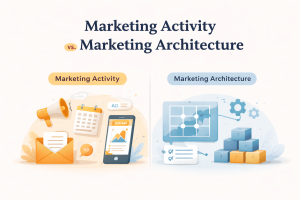
This is one reason marketing can start to feel heavier as organizations grow. The issue is not always lack of effort. Often, it is that expanding visibility creates more surface area to manage without a shared framework for how those efforts should reinforce one another.
That dynamic should sound familiar to any leader who has felt like marketing conversations are becoming more time-consuming rather than more clarifying.
When visibility was harder to earn, expanding presence often created advantage on its own.
When visibility becomes easier to generate but harder to unify, the advantage shifts. It moves toward coherence. That means organizations increasingly benefit from asking different questions than they may have a few years ago.
Not simply:
- How do we get found more often?
But also:
- When buyers encounter us in fragments, do those fragments build trust?
- Does our visibility reinforce a clear impression, or does it multiply disconnected signals?
- Are we expanding attention while also strengthening decision confidence?
These are more strategic questions, and for many organizations, they are also more stabilizing. They create a way to evaluate marketing advice against something more durable than urgency or trend pressure.
This is particularly important because not every marketing recommendation deserves equal weight. Some opportunities genuinely matter. Others are simply newer forms of noise.
Without a clear understanding of how buyers evaluate, compare, and reduce uncertainty, it becomes very easy to confuse expanding activity with strengthening strategy.
That confusion is expensive, not only financially, but mentally. It drains leadership attention, creates second-guessing, and often leads organizations to chase broader presence before they have clarified what that presence is meant to reinforce.
None of this means visibility should be ignored.
It means visibility works best when it serves something more foundational.
The strongest marketing strategies are increasingly built not just around generating awareness, but around helping buyers form stable, trustworthy conclusions in environments that are noisier and less linear than they used to be. For overwhelmed business owners, that distinction matters.
Because the answer is rarely to do everything.
It is to understand which forms of visibility actually strengthen how buyers evaluate you and which simply increase activity without increasing confidence.
Visibility still has value. But on its own, it is becoming a weaker strategy because modern buyers are not simply looking for who appears most often.
They are trying to determine who makes the most sense.
And those are not always the same thing.